01 / Selected work
Scenic Route: designing the interesting way there.
A mobile-first Paris walking product that balances destination, discovery, and the amount of extra time a person is willing to spend.
Product state
Fastest is easy to optimize. “Worth walking through” is not.
The central design decision was to make discovery an explicit routing choice and show the extra time it requires.
Two evidenced product states
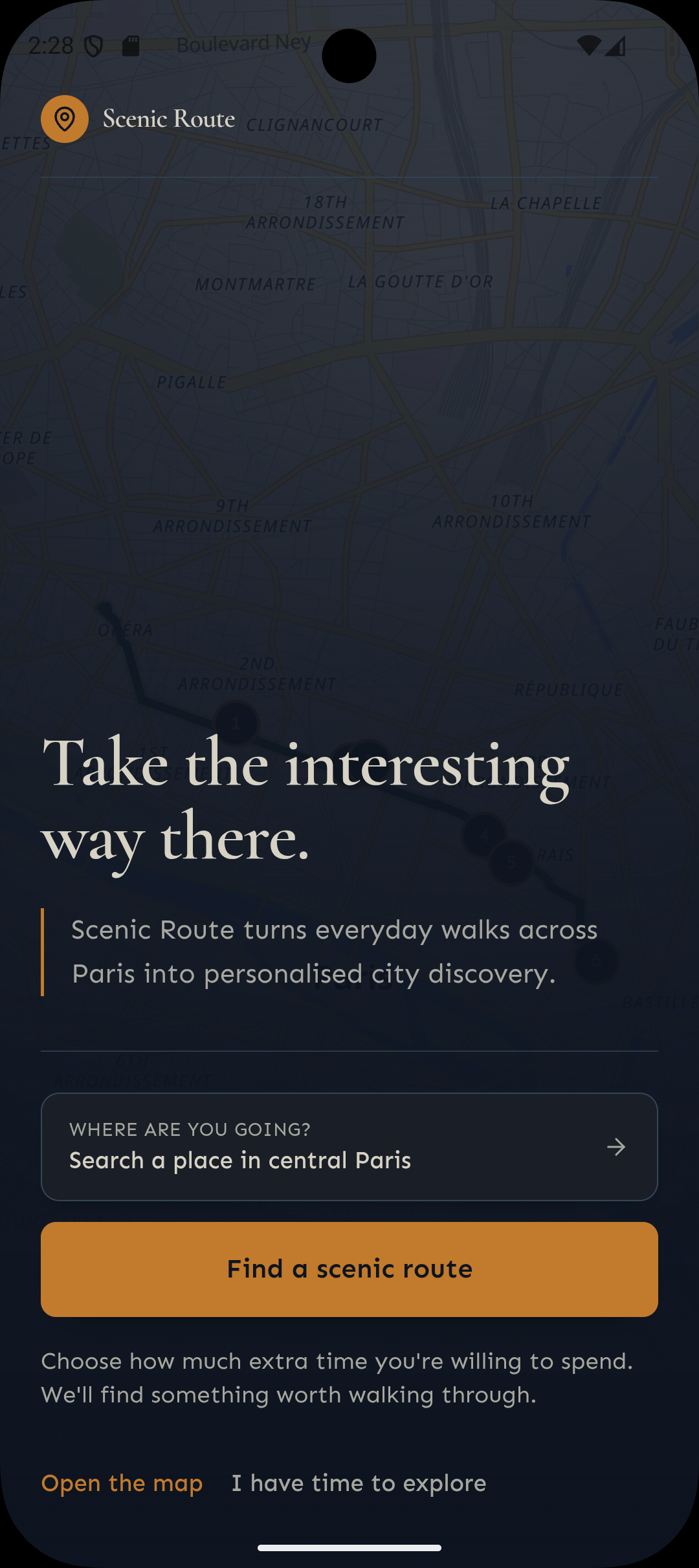

How I approached the work
Understand → Structure → Execute → Improve
Understand
Learn who is involved, what they need, and what limits the work.
Structure
Define the model, workflow, requirements, or plan.
Execute
Build the process, product, controls, and communication needed to deliver.
Improve
Test the result, use feedback, and fix what does not work.
The product decision
Four intentions, not one scenic slider.
The routing model separates the person optimizing for arrival from the person optimizing for discovery. Each mode changes intent, time tolerance, and product behavior without disguising the trade-off.
Four-mode product model
Decision system
From an intention to a defensible route.
The product must do more than draw a longer line. It generates plausible pedestrian alternatives, identifies a discovery corridor, evaluates relevant places, and respects the user’s time constraint.
Routing decision flow
Begin with an explicit destination or an open exploration intent.
Product system
Build the experience and the trust boundary together.
Location products have a particular obligation: convenience cannot make data handling invisible. The system keeps routing credentials behind a versioned backend, validates requests, and treats location as ephemeral by default.
The public figure stays deliberately architectural. It explains responsibility without exposing credentials, repository detail, or defensive configuration that would create risk.
Architecture and privacy boundaries
- No required account
- Foreground-only location
- GPS fixes not persisted by default
- Explicit sharing
Execution system
Quality is part of the product definition.
I used written requirements, tests, provider checks, and release controls to make each build inspectable. AI assistance accelerated implementation; I retained control through acceptance criteria, code review, and automated checks.
Quality pipeline
- 01Requirements
- 02Unit tests
- 03Browser E2E
- 04Provider smoke test
- 05CI gates
- 06Signed internal release
Release state
Functional, testable, and honestly bounded.
Scenic Route is a functional Capacitor-based Android application distributed through Google Play internal testing. It is not presented as a public launch, a validated business, or an AI-powered consumer feature.